"Vidas Secas": A Desolate Portrait of Human and Animal Survival in the Brazilian Backlands
Written by Camile Santana
August 13th
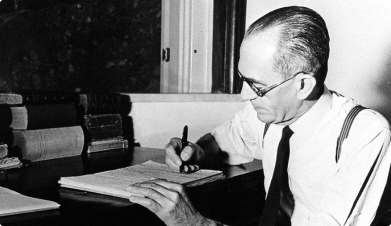
"Vidas Secas," written by Graciliano Ramos and published in 1938, is a masterpiece of Brazilian literature that delves deep into the harsh reality faced by a family of northeastern migrants during the relentless drought in the Brazilian backlands. This book not only portrays the challenges of human survival in a hostile environment but also sheds light on the struggles of animals in the face of the same adversity.
The 1930s were marked by intense social and economic transformations in Brazil. The country was still grappling with the aftermath of the 1929 crisis, exacerbating regional inequalities and intensifying the hardships faced by rural populations. In this context, "Vidas Secas" emerged as a powerful critique of living conditions in the arid regions of northeastern Brazil.
The plot follows a family consisting of Fabiano, Sinhá Vitória, their younger children, a parrot, and a dog named Baleia. Through the experiences of this family, Graciliano Ramos exposes their daily struggle for survival, lack of prospects, and social oppression. The narrative is stark, almost stripped down, reflecting the aridity of the depicted environment.
The title "Vidas Secas" carries a deep symbolic meaning. Apart from referring to resource scarcity and the harshness of the backlands, it also speaks to the absence of emotions and opportunities in the characters' lives, as well as the aridity of the human soul in the face of adversity.
The presence of Baleia, the family's dog, and the parrot adds a broader dimension to the suffering caused by the drought. How the characters interact with these animals often reveals their own humanity. The scene of Baleia's death, for instance, highlights the cruelty of living conditions and the struggle for survival not only for humans but also for animals.
"Vidas Secas" doesn't limit itself to depicting material poverty; it also denounces the social and political structures perpetuating this misery. Graciliano Ramos critiques the oppression of large landowners, the exploitation of rural workers, and the lack of effective public policies to address the issues of northeastern Brazil.
This impactful literary work transcends the boundaries of time and space, remaining relevant to this day. Through concise and impactful prose, Graciliano Ramos portrays the desperate fight for survival in an inhospitable environment, shedding light on the complexity of human and animal relationships amidst adversity. The book invites reflection on social inequalities and the human condition, while bearing witness to literature's capacity to reveal the rawest and deepest truths of existence.
Meet the Author
Graciliano Ramos, born on October 27, 1892, in Quebrangulo, Alagoas, Brazil, emerges as one of the most significant writers of 20th-century Brazilian literature. His life and work are marked by a deep sensitivity to the social and political issues of his era in Brazil.
Ramos experienced a difficult childhood, marked by the death of his mother when he was just two years old and constant moves between cities due to his father's job as a civil servant. These experiences of instability and displacement deeply impacted his worldview and later writing.
His career as a writer gained prominence with works like "Caetés" (1933) and "São Bernardo" (1934), but it was with "Vidas Secas" (1938) that he achieved international recognition. The book, which depicts the lives of northeastern migrants amidst drought, showcases not only his literary prowess but also his commitment to exposing social inequalities and injustices.
Beyond being a writer, Graciliano Ramos was also a politically engaged individual. He joined the Brazilian Communist Party and, in 1936, was elected mayor of Palmeira dos Índios, Alagoas. His tenure as mayor was marked by his efforts to improve the lives of the underprivileged and the implementation of progressive public policies.
However, his political activism led him to imprisonment during the Estado Novo, a period of authoritarian rule under Getúlio Vargas. Graciliano Ramos spent about ten months in detention, an experience that influenced his critical view of political repression and abuses of power.
After his release, Ramos continued to write and actively participate in Brazil's cultural and political life. His subsequent works, such as "Angústia" (1936) and "Viventes das Alagoas" (1942), explore themes like existential anguish and the social reality of the country.
Graciliano Ramos' writing is characterized by concise, dry, and direct prose, mirroring the aridity of the landscapes he describes. His literature combines deep psychological analysis with keen societal observations. He passed away on March 20, 1953, leaving behind a literary legacy that continues to inspire readers and writers alike. His contribution to Brazilian literature goes beyond words; he gave voice to the oppressed, the marginalized, and those yearning for justice and change.