George Orwell: The Literary Visionary Who Challenged Authorities and Predicted the Future in '1984'
Written by Camile Santana
August 12th
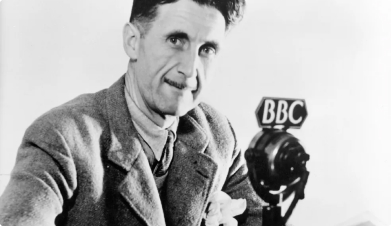
"1984" is a dystopian novel written by George Orwell and published in 1949. The work is considered one of the most influential and powerful critiques of tyranny and state surveillance ever written. The book is set in a fictional totalitarian world where the all-present State controls all aspects of citizens' lives.
The plot follows the life of Winston Smith, a Party member who works at the Ministry of Truth, where he is responsible for rewriting historical documents to align them with the government's official version. The story takes place in a world under constant surveillance, where the Party is led by Big Brother, an enigmatic and omnipresent figure. Through Winston's eyes, the reader is introduced to practices of truth manipulation, thought control, and the suppression of any form of dissent.
The central concept of the book is "doublethink," the ability to hold contradictory beliefs simultaneously and accept both of them. The Party employs this practice to control citizens' minds and maintain their loyalty to the regime, even if it means believing in blatantly false information.
The story also introduces the language of "Newspeak," an artificial language created by the Party to eliminate words that could be used to express subversive thoughts. This limits people's ability to question or challenge the government, as the language itself doesn't provide tools to express such ideas.
"1984" is a scathing critique of totalitarian regimes, information manipulation, loss of privacy, and the erosion of individual freedoms. The work has often been cited as a warning about the dangers of power abuse and the importance of constant vigilance to preserve freedom. The book is as relevant today as it was during its time of publication, continuing to inspire discussions about politics, state control, and the limits of freedom.
Meet the Author
George Orwell, whose real name was Eric Arthur Blair, was a renowned British writer and journalist born on June 25, 1903, in Motihari, British India (now part of India). He is best known for his dystopian works and insightful analyses of politics and society. His commitment to honesty, clarity, and social justice shaped his literary and journalistic career.
Orwell grew up in England and attended Eton College, an elite school. He decided to become a writer, but instead of going to university, he joined the Indian Imperial Police, where he served for a short period before resigning from colonial service. This experience in India influenced his understanding of class and imperialism, frequent themes in his work.
His most famous writings include "Animal Farm" and "1984." These dystopian works fiercely criticize abuses of power, truth manipulation, and political repression. Orwell is also known for his essayistic works, in which he tackled a wide range of topics, from politics to literature and language.
Orwell advocated for clarity in writing, emphasizing that obscure and vague language often conceals dishonest intentions. His influence can be seen in how he incorporated these principles into his own works, making them accessible to a variety of readers while exploring profound issues.
In addition to his literary career, Orwell also had a prolific journalistic career. He reported on the Spanish Civil War and fought alongside anarchist and Trotskyist militias against Francoist forces. His experiences in this war were later depicted in his book "Homage to Catalonia."
Unfortunately, Orwell battled health issues throughout much of his life and passed away at the age of 46 on January 21, 1950, in London, due to tuberculosis. His influence and legacy endure through his works, which continue to be widely read and discussed worldwide as powerful reflections on the nature of politics, power, and freedom.
aciliano Ramos' writing is characterized by concise, dry, and direct prose, mirroring the aridity of the landscapes he describes. His literature combines deep psychological analysis with keen societal observations. He passed away on March 20, 1953, leaving behind a literary legacy that continues to inspire readers and writers alike. His contribution to Brazilian literature goes beyond words; he gave voice to the oppressed, the marginalized, and those yearning for justice and change.